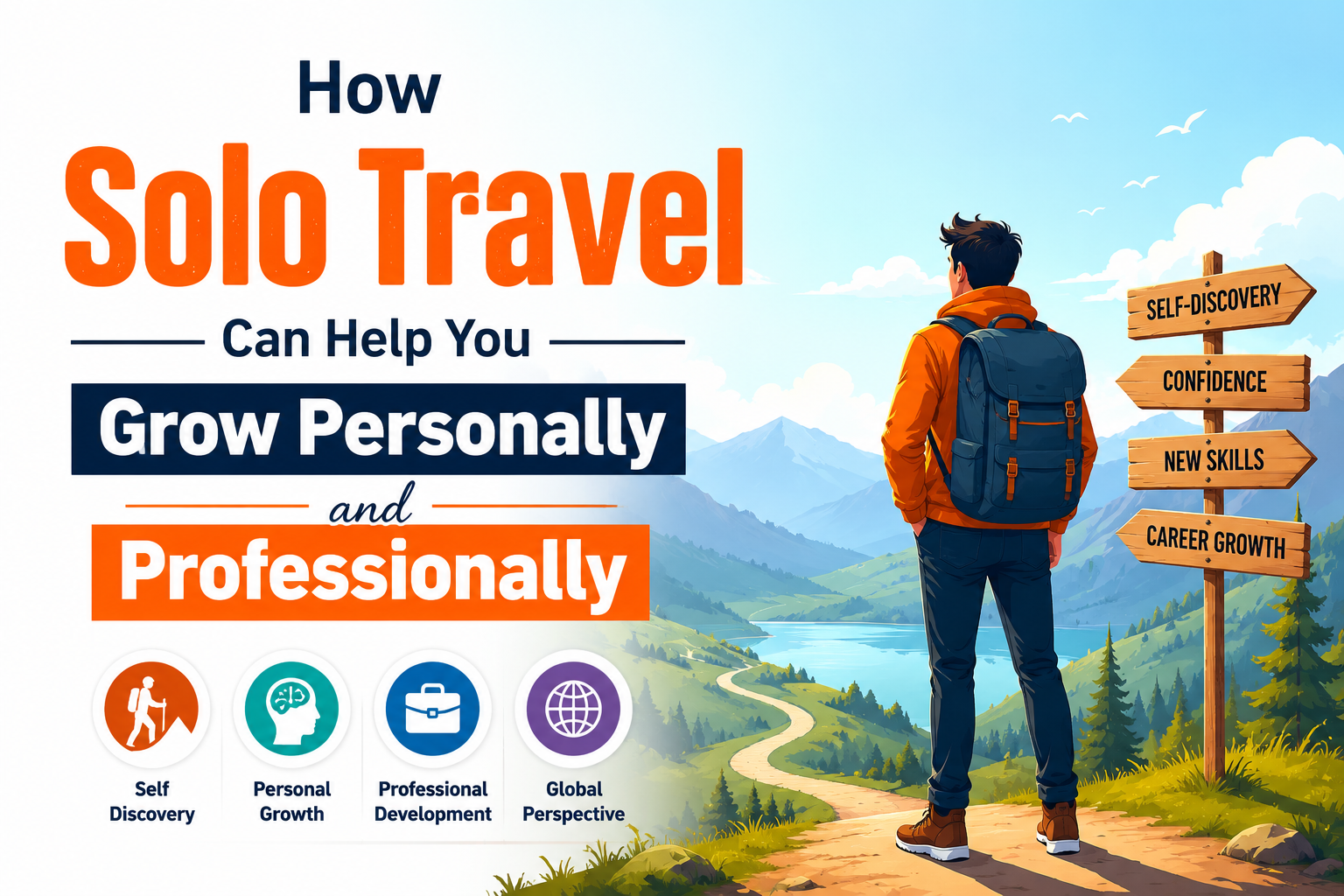
Most people think of travel as a way to relax, explore new destinations, and escape everyday routines. While travel certainly provides those benefits, solo travel offers something much deeper. Traveling alone challenges individuals to step outside their comfort zones, make independent decisions, solve unexpected problems, and engage with unfamiliar environments without relying on others. These experiences often create significant personal and professional growth that continues long after the trip has ended.
Unlike group travel, where responsibilities and decisions are often shared, solo travel places you entirely in charge of your own journey. Every choice—from transportation and accommodation to daily schedules and problem-solving—becomes your responsibility. Although this may seem intimidating at first, it is precisely this independence that makes solo travel such a powerful tool for growth and self-development.
✦ Growth Happens Outside Familiar Routines
Personal and professional development often occurs when individuals encounter new challenges, unfamiliar environments, and situations that require adaptability. Solo travel naturally creates these opportunities.
Building Self-Confidence Through Independence
Confidence grows when people successfully handle situations they once believed were difficult. Solo travel provides countless opportunities to build this confidence.
Navigating unfamiliar cities, communicating with strangers, managing transportation systems, solving travel issues, and making daily decisions independently all contribute to stronger self-belief.
Each successful experience reinforces the understanding that you are capable of handling challenges on your own.
- Navigating unfamiliar locations.
- Managing travel logistics independently.
- Communicating in new environments.
- Making important decisions alone.
- Overcoming unexpected obstacles.
Improving Decision-Making Skills
Professional success often depends on the ability to make informed decisions confidently. Solo travel creates a continuous stream of choices that require evaluation and action.
Travelers must decide where to stay, how to spend their time, which opportunities to pursue, and how to respond when plans change.
| Travel Situation | Professional Skill Developed |
|---|---|
| Planning Itineraries | Strategic thinking |
| Solving Travel Issues | Problem-solving ability |
| Managing Budgets | Financial decision-making |
The habit of making independent decisions becomes stronger with every journey.
Developing Problem-Solving Abilities
Travel rarely unfolds exactly as planned. Delayed transportation, changing weather, language barriers, missed connections, and unexpected circumstances are common parts of the travel experience.
Solo travelers must often resolve these situations independently, which strengthens adaptability and critical thinking skills.
These same abilities are highly valuable in professional environments where unexpected challenges frequently arise.
🧩 Problem-Solving Benefits
- Improved adaptability.
- Stronger critical thinking.
- Greater resilience.
- Increased resourcefulness.
- Enhanced confidence under pressure.
Learning to Communicate More Effectively
Communication is one of the most important professional skills, and solo travel often accelerates its development.
Travelers frequently interact with people from different cultures, backgrounds, and languages. These interactions encourage active listening, patience, clarity, and adaptability.
Even simple conversations can improve interpersonal skills that prove valuable in both personal and professional settings.
- Active listening.
- Cross-cultural communication.
- Confidence in conversations.
- Adaptability in social situations.
- Relationship-building skills.
Expanding Cultural Awareness
Modern workplaces increasingly operate across cultures and international markets. Understanding different perspectives has become a valuable professional asset.
Solo travel exposes individuals to diverse customs, traditions, communication styles, and ways of thinking.
Experiencing these differences firsthand often leads to greater empathy, open-mindedness, and cultural intelligence.
Increasing Adaptability and Flexibility
Adaptability is one of the most valuable skills in today’s rapidly changing world. Solo travel regularly places individuals in situations where flexibility becomes necessary.
Unexpected changes are common, and travelers learn to adjust plans while maintaining a positive attitude.
This flexibility often transfers directly into professional environments where changing priorities and unexpected developments are common.
🌍 Adaptability in Action
- Adjusting travel schedules.
- Managing changing conditions.
- Navigating unfamiliar environments.
- Responding to unexpected opportunities.
- Remaining calm under uncertainty.
Strengthening Financial Responsibility
Traveling alone often requires careful financial planning. Budgeting, tracking expenses, prioritizing spending, and making value-based decisions all contribute to stronger financial discipline.
These habits can improve personal finance management long after the trip has ended.
Professional roles that involve budgeting, resource allocation, or financial oversight also benefit from these experiences.
Discovering Personal Strengths and Interests
When traveling alone, there is no need to compromise with companions regarding schedules, attractions, or activities. This freedom often helps individuals discover what genuinely interests them.
Solo travelers frequently learn more about their preferences, strengths, values, and goals than they expected.
This self-awareness can influence future career decisions, personal priorities, and long-term life planning.
✨ Personal Discoveries Often Include
- Hidden strengths.
- New interests.
- Greater self-awareness.
- Improved independence.
- Clearer long-term goals.
Creating a Growth-Oriented Mindset
Perhaps the greatest benefit of solo travel is the mindset it develops. Successful solo travelers learn that growth often comes from discomfort, uncertainty, and new experiences.
This mindset encourages curiosity, resilience, learning, and a willingness to embrace challenges rather than avoid them.
These qualities are valuable not only for travel but for career advancement, entrepreneurship, leadership, and personal development.
| Travel Experience | Long-Term Benefit |
|---|---|
| Facing Challenges | Greater resilience |
| Exploring New Cultures | Broader perspective |
| Traveling Independently | Stronger confidence |
★ Skills Solo Travel Helps Develop
- Self-confidence.
- Decision-making ability.
- Problem-solving skills.
- Communication effectiveness.
- Cultural awareness.
- Financial responsibility.
- Adaptability.
- Leadership qualities.
- Resilience.
- Self-awareness.
Final Thoughts
Solo travel offers far more than memorable destinations and beautiful photographs. It provides a unique environment for growth by encouraging independence, resilience, adaptability, and self-discovery. Every challenge faced and every decision made contributes to stronger personal and professional capabilities.
The lessons learned through solo travel often extend well beyond the journey itself. Improved confidence, stronger communication skills, better problem-solving abilities, and greater cultural awareness can positively influence careers, relationships, and future opportunities.
For individuals seeking meaningful growth, solo travel is more than an adventure—it is an investment in themselves. The experiences gained along the way frequently become valuable assets that continue delivering benefits for years after the trip ends.